The Analog Sunset – 2026 Is the Year Digital Night Vision Takes Over
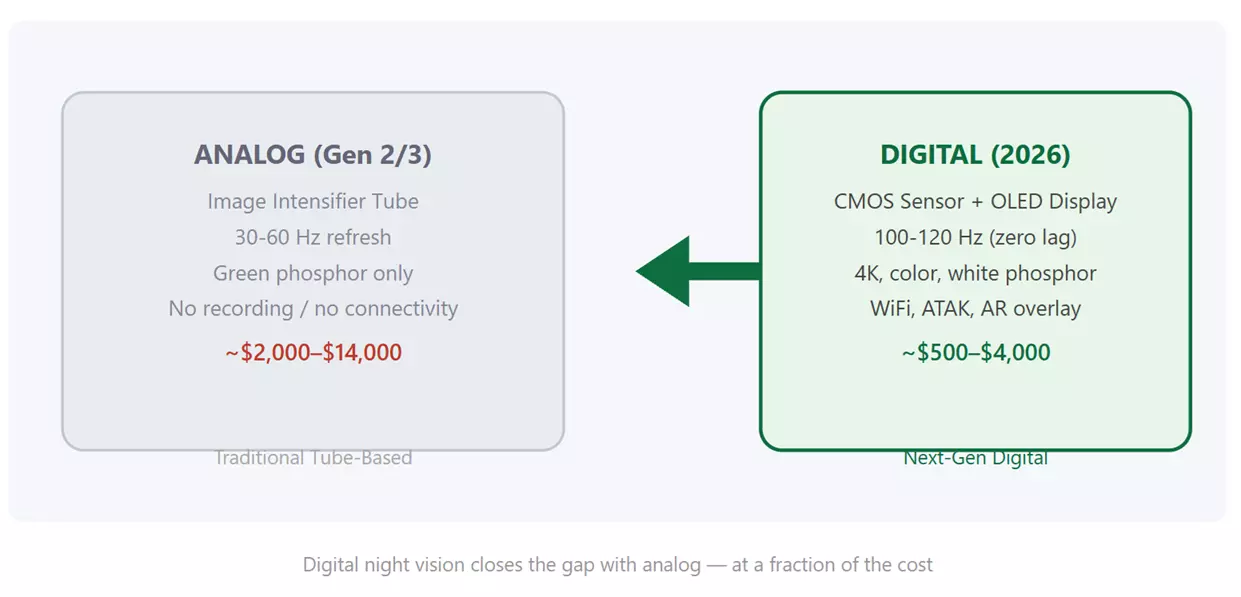
For over a decade, the night vision community was divided into two camps: those who could afford $10,000+ Gen 3 analog image-intensifier tubes, and everyone else struggling with laggy, grainy digital devices. In 2026, that divide has collapsed.
What Changed?
• 100–120Hz Refresh Rates — The number one complaint about digital NV was latency. New units like the ADNV-G14 SE and Sionyx Opsin Gen 2 now run at up to 120Hz, making motion lag imperceptible. You can drive, sprint, or navigate rough terrain without the motion sickness that plagued earlier digital devices.
• 4K-Class Sensors — The DNT Zulus 4K and Luna Optics 4K Quantum Elite (both launched at SHOT Show 2026) bring cinema-grade resolution to rifle scopes. Combined with circular high-resolution OLED displays, image clarity now rivals premium Gen 3 analog tubes.
• Built-in Ballistic Smarts — Digital scopes now integrate laser rangefinders, ballistic calculators, and ATAK-compatible HUD overlays. The scope becomes a tactical computer — projecting waypoints, friend/foe markers, and range data directly into your field of view.
• Day/Night Versatility — Unlike analog tubes that are permanently damaged by daylight, digital scopes work seamlessly in any lighting condition, from full sun to total darkness.
|
Key takeaway: Digital night vision is no longer a 'budget compromise.' It is the platform of choice for users who need recording, connectivity, and smart features — and it now performs on par with analog at roughly half the price. |
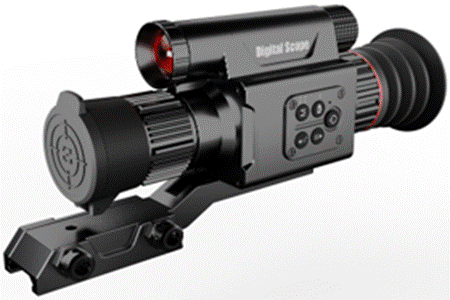
Fig. 1 — A dedicated digital night vision riflescope with built-in IR illuminator
