The Smart Revolution in Trail Cameras
The global trail camera market is undergoing its most dramatic transformation since the shift from film to digital. Valued at $925 million in 2025 and projected to reach $1.5 billion by 2032 at a compound annual growth rate (CAGR) of 7.2%, the industry is being reshaped by three converging forces: cellular connectivity, artificial intelligence, and renewable energy integration. What was once a niche tool for hunters has quietly evolved into a versatile outdoor imaging platform serving conservationists, farmers, property owners, and security professionals worldwide.
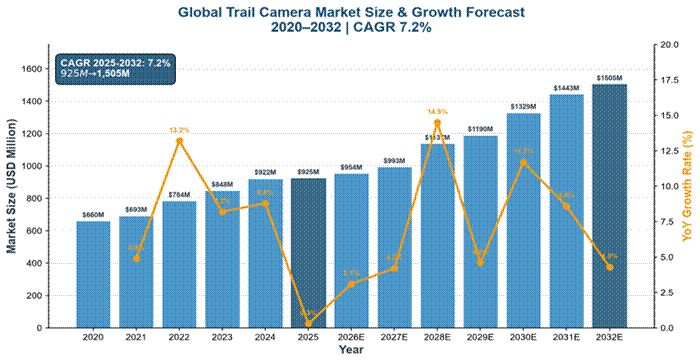
Figure 1: Global Trail Camera Market Size & Growth Forecast (2020–2032). Source: PMarketResearch, Consegic.
Cellular Connectivity Becomes the New Standard
The single biggest shift in the trail camera market is the accelerating adoption of cellular-enabled models. In 2025, cellular cameras accounted for 54.2% of global market revenue, and that figure continues to climb. The reason is simple: real-time image transmission eliminates the need for physical SD card retrieval — a game-changer for users monitoring remote properties, wildlife corridors, or hunting grounds dozens of miles from home.
Modern cellular trail cameras now support dual-SIM automatic switching between major carriers, addressing the long-standing pain point of unreliable signal in rural deployment zones. According to industry estimates, 28–35% of deployment sites previously suffered from inadequate signal strength; multi-network switching has dramatically improved connectivity robustness. With 5G integration on the horizon, the cellular revolution is far from over.
Artificial Intelligence: From Motion Detection to Species Recognition
Perhaps the most exciting innovation is the integration of onboard AI processing. Early trail cameras triggered on any movement — a blowing branch, a passing shadow — flooding users with false positives. Today's AI-powered cameras can filter out irrelevant motion with 60–70% accuracy improvement, distinguishing between wind-blown foliage and actual wildlife.
Advanced models now perform species recognition directly on the device. A camera deployed in a wildlife corridor can identify and classify animals — deer, bear, wolf — and transmit only images of target species. In 2025, China alone deployed 620,000 new ecological monitoring cameras, with 41% featuring edge-computing AI capabilities for population surveys, anti-poaching patrols, and ecological corridor monitoring.
Solar Power Unlocks Truly Autonomous Operation
Battery life has long been the Achilles' heel of remote camera deployments. Integrated solar charging systems have grown from an experimental add-on to a mainstream feature. In 2025, solar-powered cameras represented 18% of global installations, a figure rising steadily as panel efficiency improves and costs decline. The combination of solar charging, low-power electronics, and AI-driven intelligent triggering means a modern trail camera can now operate continuously for months without human intervention.
This has opened entirely new use cases: year-round wildlife population monitoring in national parks, perimeter security for remote infrastructure, and precision agriculture applications where cameras track crop health and livestock movement. New IATA lithium battery transport restrictions taking effect in 2026 are further incentivizing solar adoption across the industry.
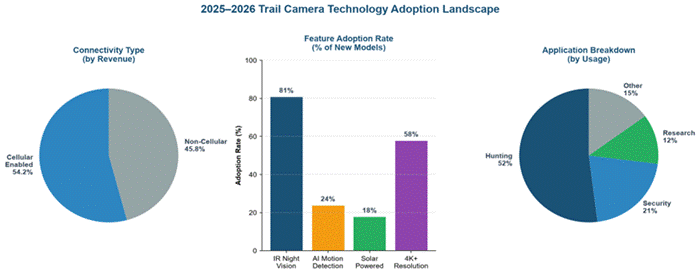
Figure 2: 2025–2026 Trail Camera Technology Adoption Landscape. Source: Precision Reports, Consegic.
Beyond Hunting: The Expanding Application Landscape
While hunting still represents 52% of trail camera usage, the application landscape is diversifying rapidly. Wildlife monitoring and conservation now account for a growing share, driven by government biodiversity commitments and AI-powered species identification. Security surveillance — for rural properties, construction sites, and agricultural facilities — is emerging as a major growth vertical, accounting for 21% of the market.
The category has even spawned consumer offshoots: bird-feeder cameras and backyard wildlife observatories are gaining traction in Europe and North America, turning casual nature observation into a connected smart-home experience. This expansion is drawing new demographics — homeowners, educators, citizen scientists — who would never have considered purchasing a hunting camera five years ago.
Regional Dynamics and Supply Chain Realities
North America remains the dominant market, commanding 59.3% of global revenue ($548.7 million in 2025), driven by a hunting culture of 15.2 million licensed hunters and extensive rural property ownership. Europe follows with $185.1 million, while Asia-Pacific is the fastest-growing region at 6.3% CAGR, fueled by conservation investments and agricultural modernization.
However, the industry faces headwinds. New U.S. Section 301 tariffs on Chinese-origin lithium-ion batteries and components rose to 25% in 2026, directly impacting trail camera supply chains. Manufacturers are responding by diversifying supplier bases and shifting production to markets with favorable trade terms.
What This Means for Buyers and the Industry
For buyers — whether a hunter in Texas, a conservation researcher in Kenya, or a farmer in Australia — the message is clear: trail cameras have never been more capable, more intelligent, or more connected. The convergence of AI, solar power, and cellular connectivity is creating devices that think for themselves, power themselves, and keep you informed from anywhere on the planet.
For manufacturers and distributors, the strategic imperative is equally clear: invest in AI and connectivity, design for solar integration, and prepare for a market that is expanding far beyond its hunting roots. The billion-dollar trail camera industry of 2032 will look very different from the one we see today — and the companies that embrace this transformation now will be the ones leading it.
GrandVisionTech offers a comprehensive range of trail cameras featuring 4G connectivity, solar charging, and AI-enhanced imaging. Explore our product line at grandvisionsz.com.
Sources: PMarketResearch, ResearchAndMarkets, Consegic Business Intelligence, Precision Reports, Lucintel (2025–2026).
