Night Vision in 2026
The night vision industry is experiencing a watershed moment. Long dominated by military contracts and classified technology, the sector is being reshaped by three unstoppable trends: AI-powered image processing, multi-spectral fusion systems, and an explosive surge in civilian demand. With the global night vision equipment trade reaching $203.6 billion in 2025 and civilian applications approaching 50% of total market share, 2026 is being called the year night vision goes mainstream.
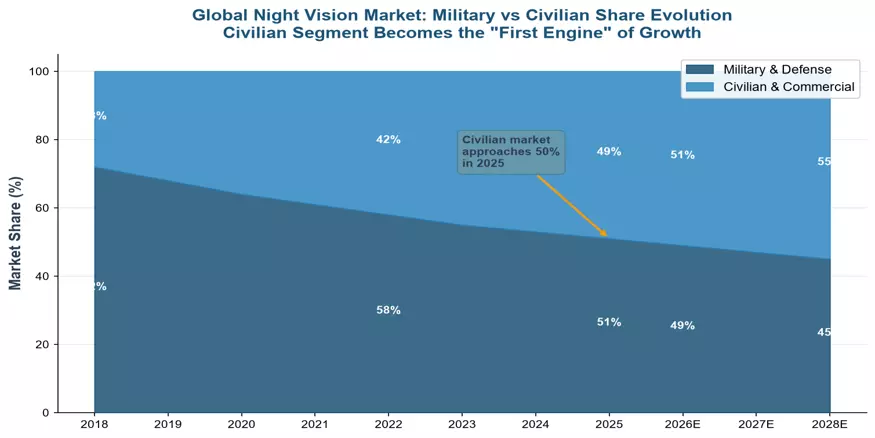
Figure 1: Global Night Vision Market — Military vs. Civilian Share Evolution (2018–2028). Source: Inwwin.com.cn, US Night Vision.
AI Meets Night Vision: The Dawn of Intelligent Imaging
2026 is widely recognized as the critical inflection point for AI integration in night vision. What was once a simple light-amplification tube is now a smart imaging platform. AI algorithms handle real-time noise reduction, adaptive image enhancement, target classification, and behavioral analysis — all processed on-device with near-zero latency.
In extremely low-light conditions — 0.01 lux or darker — next-generation AI denoising algorithms can now output full-color images without infrared illumination, achieving clarity levels that were science fiction just three years ago. For hunters tracking game at dawn, security personnel monitoring perimeters, or wildlife researchers conducting nocturnal surveys, this leap in image quality is transformative.
The numbers tell the story: in 2025, 31.2% of all new night vision patents were AI and digital image processing related, up 15 percentage points from 2020. Companies from defense primes to consumer electronics startups are racing to embed machine learning models directly into night vision firmware, turning passive viewing devices into active analytical tools.
Fusion Systems: The Best of All Worlds
The era of single-technology night vision is ending. Multi-spectral fusion — combining thermal imaging, low-light sensors, and even laser rangefinders into a single device — is the defining hardware trend of 2026. Military programs have led the way with the U.S. Army's ENVG-B and the upcoming IVAS 1.2 system, which overlay thermal heat signatures onto traditional image-intensified views with augmented reality navigation cues.
Critically, this fusion technology is now trickling down to civilian and commercial markets. Affordable hybrid devices combining thermal spotting with digital night vision for detailed identification are entering the prosumer segment. A hunter can use thermal to detect a heat signature in dense brush at 300 meters, then switch to low-light digital magnification for positive identification — all in a single handheld device priced for enthusiasts, not defense budgets.
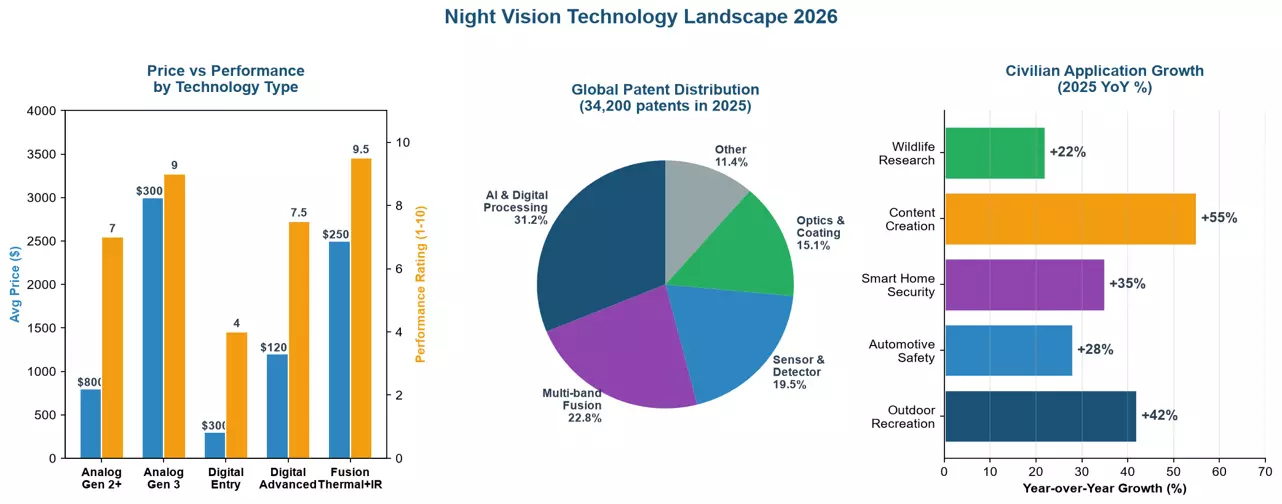
Figure 2: Night Vision Technology Landscape 2026 — Price vs. Performance, Patent Distribution & Civilian Growth. Source: MarketSizeAndTrends, Chinairn.com.
The Civilian Market: From Niche to First Engine
Perhaps the most consequential shift is demographic. Civilian applications now represent nearly half of global night vision demand and are growing faster than military and law enforcement segments combined. Several forces are driving this: the outdoor recreation explosion including camping, night hiking, and wildlife observation; automotive integration with night vision becoming standard in premium vehicles; smart home security with AI-powered human detection; and content creation where YouTubers and documentary filmmakers discover the creative possibilities of recording in total darkness.
For the average outdoor enthusiast, the choice is increasingly clear: a capable digital night vision monocular with AI enhancement, Wi-Fi connectivity, and onboard recording offers far more utility than a bare-bones analog tube at the same price point.
Digital vs. Analog: The Gap Narrows
For decades, the night vision hierarchy was clear: analog image intensifier tubes (Gen 2+, Gen 3) delivered superior low-light performance, while digital sensors were cheaper but noisier. That hierarchy is collapsing. Digital night vision has improved dramatically, driven by advances in CMOS sensor sensitivity, AI noise reduction, and white phosphor displays. Modern digital devices at $300–800 now deliver performance that rivals Gen 2+ analog tubes costing three times as much.
Meanwhile, filmless white phosphor tubes with Figure of Merit (FOM) ratings exceeding 2500 represent the state of the art in analog — but their premium pricing increasingly positions them for military and professional applications only.
China's Night Vision Industry Goes Global
A major subplot in 2026 is the accelerating globalization of China's night vision manufacturing sector. Chinese companies are rapidly expanding international distribution, particularly across Belt and Road Initiative countries in Southeast Asia, the Middle East, and Africa. The competitive advantage lies in cost-effective uncooled thermal sensors and complete device integration. While the country still imports $42.8 billion in high-end image intensifier tubes, its domestic non-cooled infrared focal plane array production is scaling rapidly, with a target of 65% self-sufficiency in core night vision chips by 2028.
For international buyers, this means more choice, more competitive pricing, and more feature-rich products — particularly in the mid-range and entry-level segments that matter most to civilian users.
What's Next: Quantum Sensors and the Connected Battlefield
Looking further ahead, the night vision roadmap is astonishing. Quantum sensor-based systems, currently in early research, promise to surpass current resolution and sensitivity limits by detecting individual photons. Augmented reality overlays integrated into night vision goggles will provide real-time target identification, navigation, and threat assessment. Cloud-connected platforms will allow remote experts to see what a field operator sees, enabling real-time tactical guidance.
For now, the practical takeaway is this: night vision technology has never been more accessible, more capable, or more diverse. Whether you are a hunter needing to track game at first light, a property owner securing rural acreage, or an outdoor enthusiast documenting nocturnal wildlife, there has never been a better time to invest in seeing in the dark.
GrandVisionTech supplies a comprehensive range of night vision devices — from digital monoculars and rifle scopes to binocular telescopes and thermal imaging systems. Explore our product line at grandvisionsz.com.
Sources: US Night Vision, TS2.tech, MarketSizeAndTrends, Chinairn.com, Inwwin.com.cn, FLIR/ATN/Bushnell announcements (2025–2026).
