The Stabilization Trilogy: How Action Cameras Turn Chaos Into Cinema
The Three Generations of Stabilization
Action camera stabilization hasn't followed a single linear path. Three distinct approaches have coexisted and competed over the past decade, each solving the problem differently.
Mechanical gimbals (2013–2018 peak). Three-axis brushless motor gimbals physically counter-rotate the camera body to cancel motion. They work beautifully — zero crop, zero image degradation — at the cost of weight, bulk, power consumption, and mechanical fragility. A gimbal-equipped action rig weighs 300–600 grams versus 80–120 grams for a standalone camera.
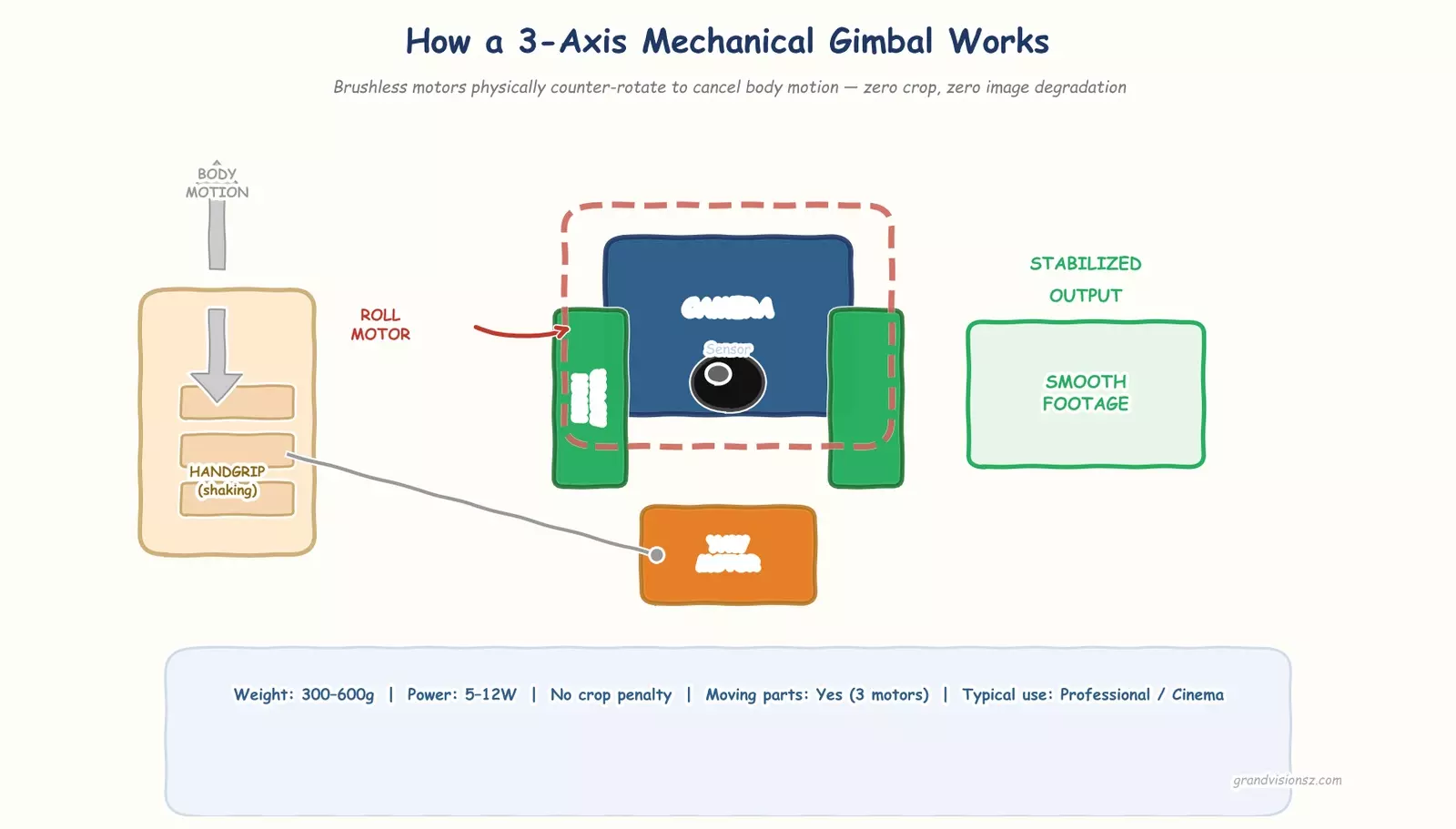
Figure 2: A three-axis gimbal uses independent brushless motors for yaw (base rotation), pitch (side tilt), and roll (barrel rotation). The camera body is suspended at the intersection of all three axes. When the user's hand shakes, the motors counter-rotate in real time to keep the camera level — delivering cinema-grade stability with zero image degradation, at the cost of significant weight and mechanical complexity.
Optical image stabilization — OIS (2015–present). A floating lens element, driven by voice-coil motors or MEMS actuators, physically shifts to compensate for small angular movements. OIS corrects perhaps 1–2 degrees of shake — useful for hand tremors and subtle platform vibration, but inadequate for the violent motion of motorsports or downhill skiing. Most modern action cameras use OIS as a complement to electronic stabilization, not a replacement.
[ FIGURE — How Optical Image Stabilization (OIS) works ]
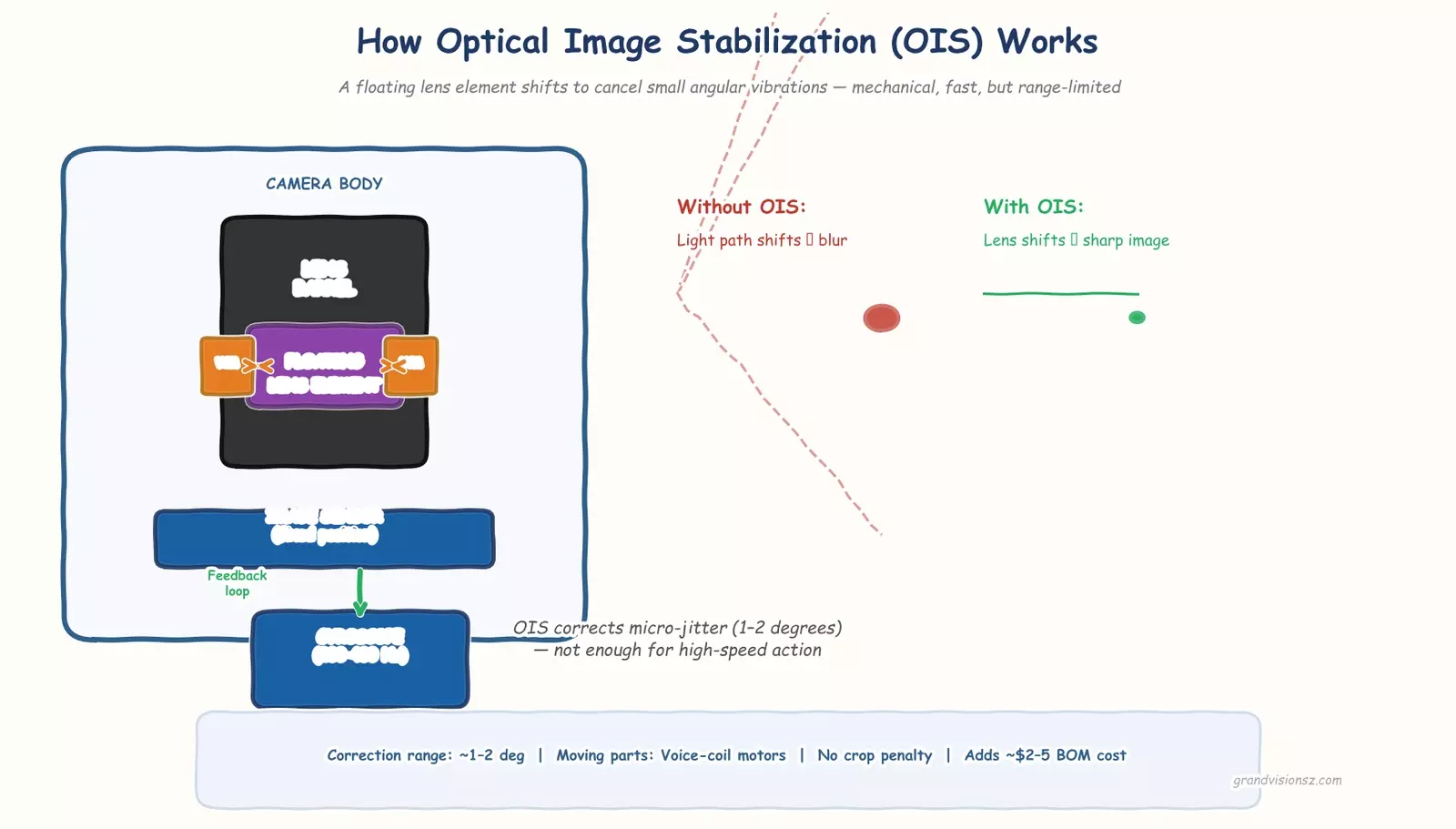
Figure 3: OIS operates on a closed feedback loop. A gyroscope chip detects angular vibration and sends correction signals to voice-coil motors (VCMs) flanking a single floating lens element. The VCMs shift the lens laterally to redirect the light path back onto the center of the sensor — correcting 1-2 degrees of shake with no crop penalty. However, the limited movement range of the floating element means OIS alone cannot handle the violent, multi-axis motion of action sports.
Electronic image stabilization — EIS (2018–present, dominant). No moving parts. The camera uses gyroscope and accelerometer data — sampled at 200–1000 Hz — to map the exact orientation of the camera body for every frame. The image signal processor then crops into a slightly larger sensor area and digitally shifts, rotates, and warps each frame to cancel the measured motion. This is the technology behind GoPro's HyperSmooth, DJI's RockSteady, and every flagship action camera since 2018.
[ FIGURE — How Electronic Image Stabilization (EIS) works ]
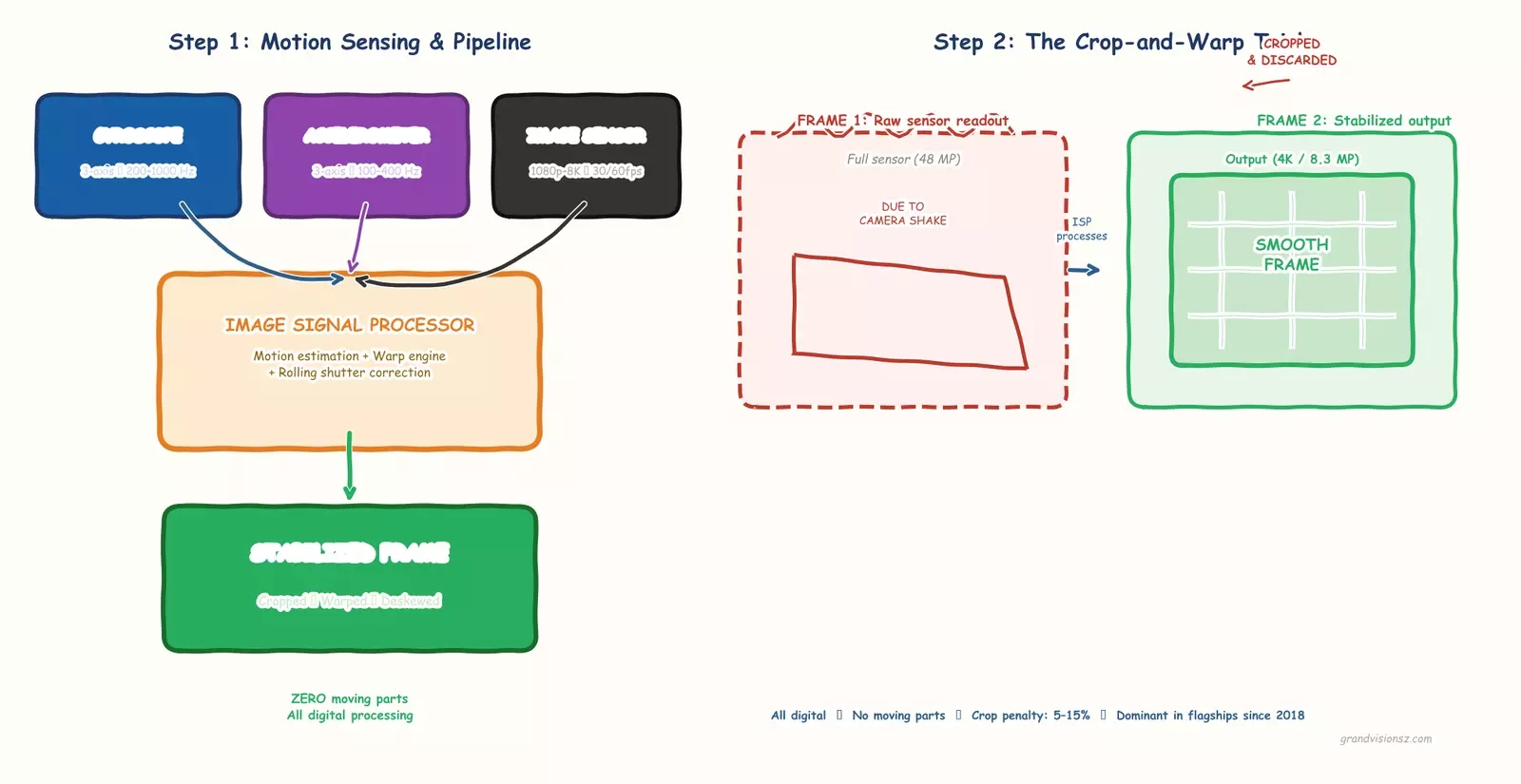
Figure 4: EIS relies on a two-stage data pipeline with zero moving parts. Stage one (left): gyroscope, accelerometer, and image sensor data stream into the ISP at 200–1000 Hz. The ISP performs motion estimation, warp transformation, and rolling shutter correction in a single pass. Stage two (right): the ISP crops the full sensor readout (e.g., 48 MP) down to the output resolution (e.g., 4K / 8.3 MP), using the extra sensor area as stabilization headroom. The stabilized frame is geometrically perfect — but 5–15% of the sensor area is discarded in the process.
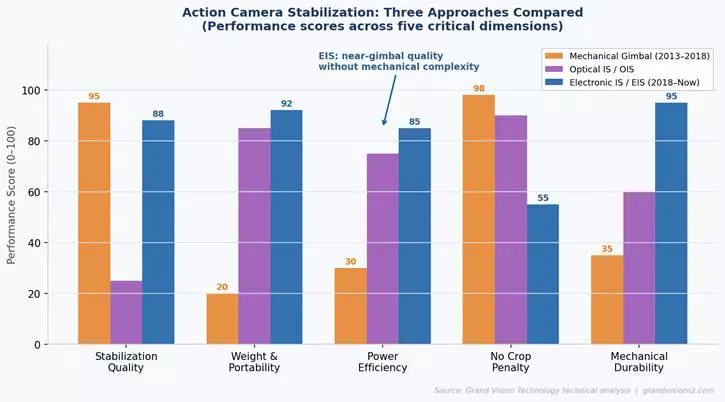
Figure 1: Three approaches to action camera stabilization compared across five performance dimensions. EIS dominates modern flagships because it delivers near-gimbal stability at a fraction of the weight, size, and power cost — though it comes with a crop-factor trade-off that gimbals avoid entirely. The three principle diagrams on the following pages explain the physical mechanism behind each approach.
What Happens Inside the Camera, Frame by Frame
The magic of modern EIS happens in a pipeline that runs 30 or 60 times per second. Here is what happens between the moment light hits the sensor and the moment a stabilized frame is written to the SD card.
Step 1: Gyroscope sampling. A MEMS gyroscope measures angular velocity on three axes at 200–1000 Hz. This means the camera knows its exact rotational position — pitch, yaw, and roll — to sub-degree precision, far faster than the video frame rate. The gyroscope data stream is time-synchronized with the image sensor's rolling shutter readout so that every row of pixels can be associated with a precise orientation.
Step 2: Motion trajectory calculation. The ISP computes the camera's motion trajectory across the duration of each frame exposure. This step is computationally intensive because rolling shutter sensors expose pixels row by row — the bottom of the frame is captured slightly later than the top, and during fast motion, that time difference translates to geometric distortion that the algorithm must also correct.
Step 3: Warp and crop. Using the motion trajectory, the ISP applies a perspective warp to the full sensor image — shifting, rotating, and de-skewing every pixel — so that the output frame appears as if the camera had been perfectly still during exposure. Because the warp pulls pixels from the edges toward the center, the output frame is a crop of the full sensor readout. Typical crop factors range from 5% in mild conditions to 15% in extreme motion — which is why stabilization is usually more aggressive in wide-angle modes that start with extra field of view to spare.
Step 4: Rolling shutter correction. Fast horizontal motion combined with rolling shutter readout creates the distinctive "jello" skew effect. Modern EIS pipelines correct this by applying a per-row geometric transform, effectively straightening vertical lines that would otherwise appear slanted.
Why Hardware Still Matters
EIS is software-driven, but the hardware underneath determines its ceiling. Three components are critical.
Gyroscope quality and sample rate. Consumer-grade MEMS gyros typically sample at 200 Hz. High-end action cameras use 400–1000 Hz gyroscopes with lower noise floors, enabling more accurate motion estimation at high speeds. This is the single component most directly correlated with stabilization quality.
Crop headroom — sensor resolution and field of view. EIS stabilizes by cropping. A 12-megapixel sensor shooting 4K video (8.3 MP) has roughly 30% spare pixels for stabilization cropping before resolution drops below 4K. A 48-megapixel sensor shooting 4K has enormous headroom — which is why higher-megapixel sensors enable more aggressive EIS without visible resolution loss.
ISP processing power. Every frame must be geometrically warped in real time at 30 or 60 fps. This requires a capable ISP with dedicated warp engine hardware, not a general-purpose CPU. Chipsets like Ambarella's H22 and Novatek's NT96683 include hardware warp blocks specifically designed for EIS pipelines.
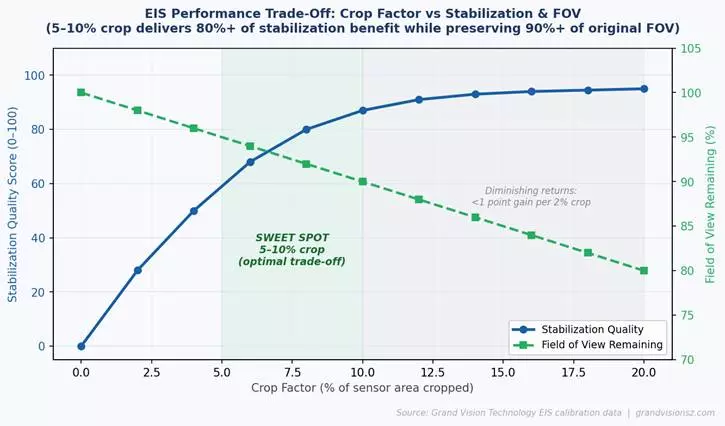
Figure 5: The fundamental trade-off in electronic image stabilization. More aggressive stabilization (lower motion blur, smoother footage) requires more cropping — which narrows the field of view. The sweet spot for most action use cases sits between 5% and 10% crop, where stabilization quality improves sharply with minimal FOV penalty. Beyond 12–15%, the FOV loss becomes visually noticeable and most manufacturers cap their stabilization algorithms accordingly.
The Platform Landscape
Most consumers know stabilization by brand names — HyperSmooth, RockSteady, FlowState — but these are built on a small number of underlying ISP chipset platforms.
The gap between flagship and entry-level EIS is dramatic. A 1000 Hz gyro feeding a purpose-built warp engine produces footage that genuinely rivals a mechanical gimbal. A 100 Hz gyro with software-only digital image stabilization produces borderline unusable results in high-motion scenarios.
For OEM buyers, this chipset layer is where cost and quality are negotiated. A manufacturer's choice of ISP platform determines the ceiling of achievable stabilization quality regardless of sensor resolution or lens quality.
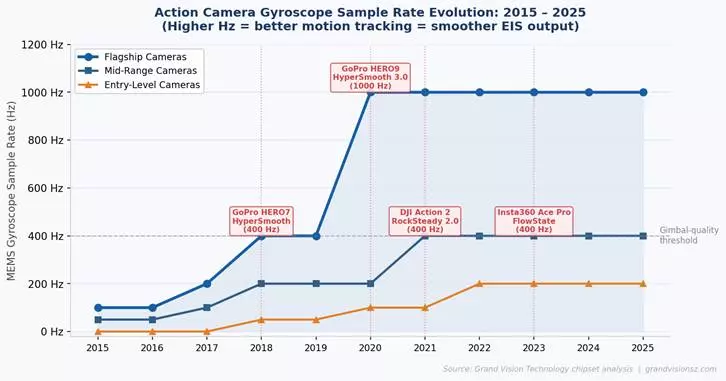
Figure 6: The evolution of MEMS gyroscope sample rates in action camera chipsets, 2015–2025. The jump from 100 Hz to 400–1000 Hz between 2018 and 2020 is what enabled software-based electronic stabilization to finally surpass mechanical gimbals in practical performance. Each step up in sample rate directly improves the accuracy of motion estimation — particularly for high-speed rotational movements.
What This Means for Buyers and Sourcing
Understanding the technology translates directly into better buying decisions. Here is what to look for.
Not all EIS is created equal. "Electronic Image Stabilization" on a specification sheet tells you nothing about quality. The chipset and gyro sample rate are the real specifications. If a manufacturer cannot tell you the ISP platform and gyro specifications behind their EIS implementation, the stabilization is likely software-only and low-quality.
Sensor megapixels matter for stabilization headroom. A higher-resolution sensor shooting at a given output resolution provides more cropping headroom, which directly enables better EIS performance. This is one reason why 48 MP sensors in 4K cameras produce visibly better stabilization than 12 MP sensors in 4K cameras — even when both claim "EIS."
Test with fast rotational motion. The most common stabilization failure mode is rapid rotation — whether from fast panning or the vibration pattern of handlebar-mounted cameras on rough terrain. Vertical linear shake (walking, running) is the easiest motion for EIS to cancel. When evaluating a camera's stabilization quality, test with deliberate fast panning — this is where the gyro sample rate difference between 200 Hz and 1000 Hz is most visible.
OIS + EIS is becoming standard at mid-tier. As OIS actuator costs decline, manufacturers are combining OIS for micro-jitter correction with EIS for large-motion stabilization. The combination produces superior results to either technology alone, particularly in low-light conditions where EIS crop factors can amplify sensor noise.
The Outlook
Stabilization technology in action cameras is approaching a plateau in traditional EIS quality — we are near the point where further gyro sample rate increases yield diminishing returns. The next frontier is likely AI-assisted stabilization. Early implementations use scene analysis to distinguish intentional camera movement (panning to follow a subject) from unintentional shake, applying asymmetric correction that preserves deliberate motion. This capability is already present in GoPro's HyperSmooth 5.0 with Horizon Lock and AutoBoost, and will almost certainly become standard across the category within two to three product generations.
For manufacturers, the competitive differentiation is shifting from "how stable is the footage" to "how stable is the footage while preserving the feel of motion." The best stabilization is the one the viewer does not notice.
Shenzhen Grand Vision Technology Co., Ltd designs and manufactures action cameras, trail cameras, and night vision devices for global export. Our action camera line spans entry-level 1080p models to 4K flagships with hardware EIS and multi-axis gyroscope stabilization. For volume pricing, OEM discussion, or specification inquiries, contact sales@grandvisionsz.com.
